
“Those who cannot remember the past are condemned to repeat it.”
-George Santayana1
Key Takeaways
The closure of the Strait of Hormuz underscores the fragility of global energy markets, driving higher prices and exposing structural vulnerabilities
Echoing 2022, energy stocks have benefited from scarcity-driven repricing, while technology names struggled with overvaluation, declining free cash flow, and tightening funding conditions
Geopolitical instability, coupled with a challenging macroeconomic environment, calls for a focus on mitigating downside risks and prioritizing durable earnings in our view
Resilience Amid Familiar Trends of 2022
As the first quarter of 2026 came to a close, global equity markets experienced a stark sectoral rotation reminiscent of the first quarter of 2022. Technology and technology-adjacent stocks—certainly, the darlings of the last several years—sharply underperformed, while energy stocks outperformed, mirroring the trends we observed in early 2022. From a US energy sector perspective, the performance across Q1 2022 and Q1 2026 is strikingly similar.
History Often Rhymes
In our view, investors remain far too complacent regarding the ensemble of risks that exist on a global basis: rising bond yields, stretched valuations, central banks either staying put or hiking rates, re-accelerating inflation, declining free cash flow in the tech sector, cracks emerging in private credit, and more. Even the earnings story itself at the index level has become incredibly narrow. Roughly 80% of the revisions to 2026 and 2027 S&P 500 earnings over the past year have been driven by a handful of AI-related businesses. As we have written at length in our Dotcom on Steroids series, we think the growth story behind these earnings is far less reliable than many believe. Recall that earnings revisions for banks were still fairly positive far too late into 2007!
Of course, what dominated the headlines during the quarter were the events that unfolded in the Middle East during March. We hope for an end to the conflict and a quick, peaceful resolution to what has unfolded over the last several weeks. However, this is undeniably a complex situation. Even if it were resolved overnight, we believe there are longer-term impacts stemming from what has already occurred, particularly regarding energy infrastructure and diplomatic relations across countries.
Nearly 80% of Earnings Revisions Driven by AI-Related Stocks
Worse than 2022?
One way in which 2026 differs from 2022 is that we believe the current crisis has the potential to be far worse, particularly because 2022 was driven by the fear of an energy shock, whereas 2026 is actually delivering one.2
It is also important to underscore that capital cycles still exist. Years of underinvestment tend to result in structurally higher returns on invested capital, whereas years of overinvestment generally do the opposite. This contrast is particularly striking when looking at what is happening globally in both energy and technology. Many market participants may be mistaking the real world for the metaverse, where things can be built or demolished without any real consequences. Ironically, the metaverse is basically a failed $80B project, in our view.3 Imagine the positive impact $80B could have if it were invested in something physically useful!
Supply Shock
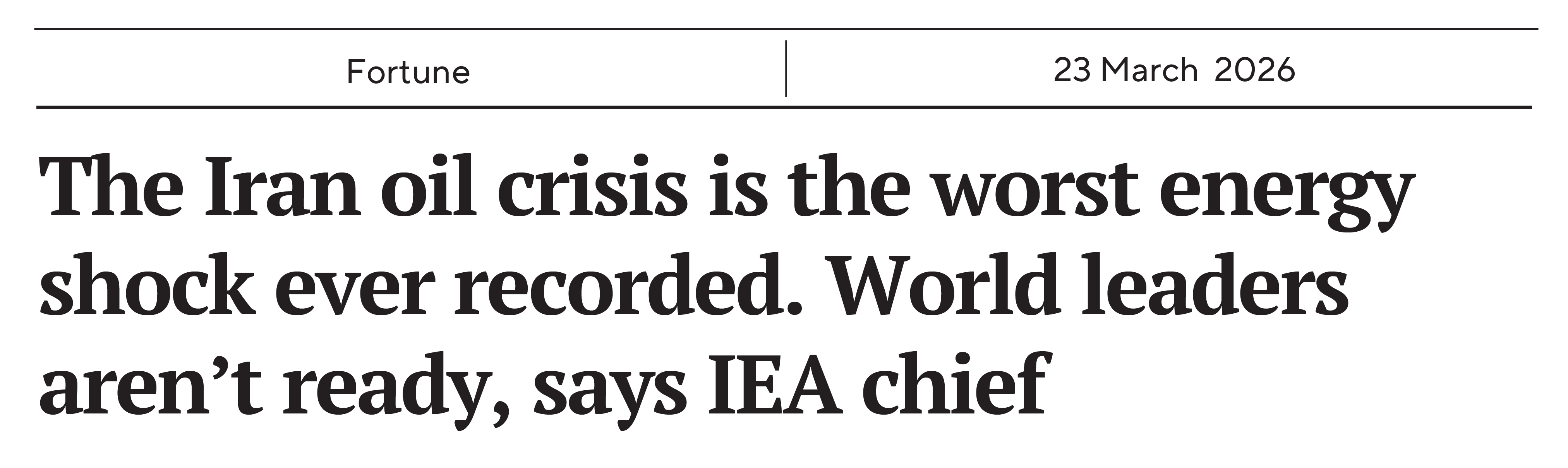
The closure of the Strait of Hormuz in early March removed roughly 20% of global seaborne crude oil and 25% of LNG trade in a single stroke. Unlike the metaverse, the real world has tangible costs and resource constraints that cannot be fixed by pressing a button. In fact, Qatar estimates that it will take three to five years to bring back the nearly 17% of LNG production that has been lost since the start of the war.4 Countries across the globe are implementing various policies to mitigate higher energy prices, from fuel rationing in Australia, to price controls in Korea, as well as various gas tax exemptions across Europe and a relaxation of the Jones Act in the US.5,6
As a net result of all of these dynamics, we are faced with an equity landscape that looks and feels like a turbocharged 2022. Back then, many market participants were flocking to energy as a hedge against uncertainty. Fast forward to today, and it reflects a structural repricing of scarcity.
In 2022 the tech market was slowly coming to terms with overvaluation, peak earnings, and peak expectations. Today, we think we have a similar negative cocktail, where investors are slowly waking up to the fact that not only are valuations too high, but many of these companies are also overearning and now struggling to finance their operations internally. This is evident in the declining forward free cash flow yields amongst the hyperscalers. As more evidence of market skepticism, Oracle, the poster child for the insatiable debt-fueled growth binge, has now seen their credit default swaps surpass the peak of the Global Financial Crisis.
From the Upper Left, to the Bottom Right
Oracle’s Five-Year Credit Default Swap Spread Surpasses 2008
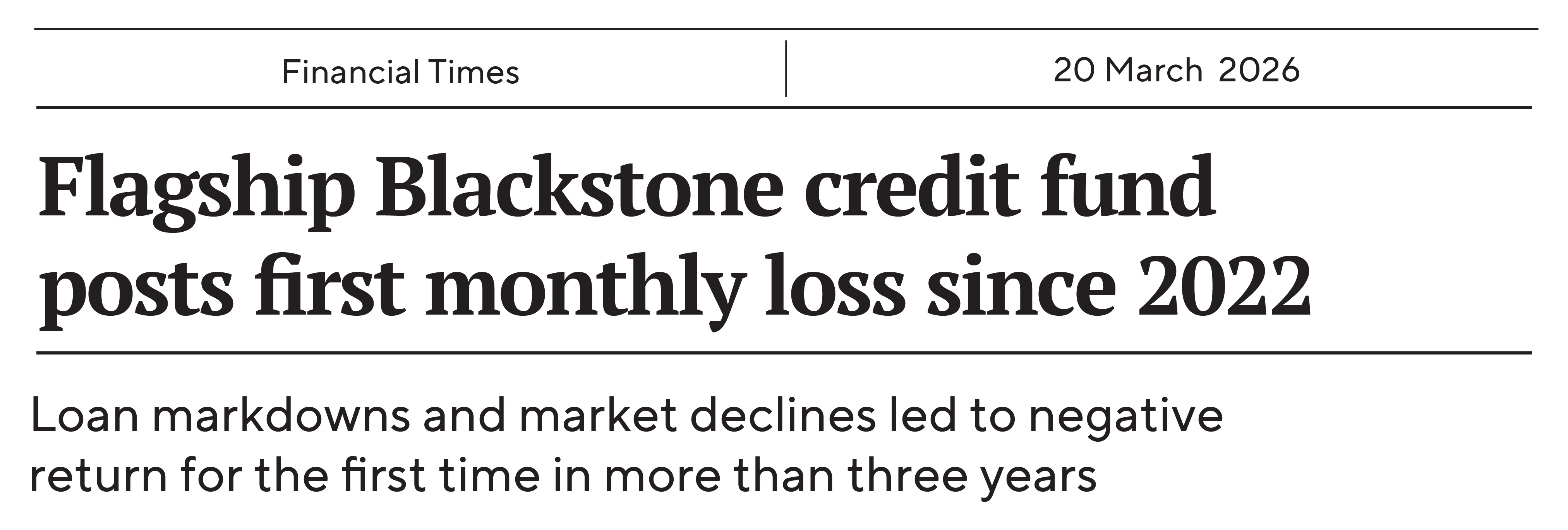
Beyond this, many companies across the AI landscape, most of which are unable to self-fund due to large losses, may have a more difficult time getting external funding as private equity starts to crack. While there were many headlines on the subject throughout the quarter, one from the Financial Times caught our attention: Flagship Blackstone credit fund posts first monthly loss since 2022.
Widening Cracks in Private Credit
MEMORY MARKET MELTDOWN?
Of course, none of these developments are simply confined to the US, as energy, technology, and funding markets are inherently global in nature. One area where we are beginning to see cracks—and which has been a pain point for us over a couple of quarters—is the memory market. From an emerging markets perspective, Korea has performed relatively well, but it is an area where we remain underweight. A key reason is that memory is arguably the most cyclical segment of the semiconductor industry. When it performs well, growth can be rapid, but when it declines, the downturn often happens just as quickly. It appears we are starting to see some early signs of prices rolling over. For example, about a week after the announcement that Google Research was rolling out a new compression algorithm, which as they noted “reduces LLM key-value cache memory by at least 6x”, Taiwan’s Economic Daily News reported the following:
“According to multiple foreign media reports, e-commerce platforms in the US market were the first to reflect the pressure. For example, on Amazon, the price of a 32GB 6400MHz DDR5 module fell from a high of $490 to $379.99, a correction of nearly 30%; the 16GB 5200MHz DDR5 module dropped from $260 to $219.99, a decrease of over 15%. Industry insiders point out that this is the first significant price drop in recent months, and the simultaneous price adjustments across multiple platforms indicate that end-user demand is becoming more conservative under the pressure of high prices.”7
These reports, and ultimately price declines, also follow speculation that a major AI company has placed quite large, yet “non-binding,” orders with both SK Hynix and Samsung simultaneously. While we do not take such speculation at face value, it does, in our view, highlight the risk to current pricing dynamics, especially if some large AI projects and data centers ultimately do not come to fruition.
In closing, 2026 has so far looked like a louder, more amplified version of 2022. While we remain “calibrated optimists” over the long term, the conditions that have been slowly deteriorating for the past year—now further exacerbated by recent events—keep us grounded as “cautious realists.”
To compound capital over time, we believe it is critical to focus on attempting to mitigate downside risk when the signs point to increased uncertainty ahead. In our view, we do not see clear signals of stabilization and believe risks remain elevated. Nevertheless, we will continue to monitor the data closely, with a focus on durable, high-quality earnings.
As always, thank you for your support.
Rajiv Jain
Chairman & Chief Investment Officer
GQG Partners LLC
END NOTES
1Santayana, George. “Reason in Common Sense: The Life of Reason.” (Prometheus). 1 May 1998.
2Angelo, Jake. “The Iran oil crisis is the worst energy shock ever recorded. World leaders aren’t ready, says IEA chief.” Fortune. 23 March 2026.
3Ritson, Mark. “Mark Ritson: Meta can kill the metaverse. It can’t escape the name.” The Drum. 30 March 2026.
4El Dahan, Maha, et al. “Exclusive: Iran attacks wipe out 17% of Qatar’s LNG capacity for up to five years, Qatar Energy CEO says.” Reuters. 19 March 2026.
5Kimathi, Sharon Kits. “Oil shortage brings curbs on work and travel.” Reuters. 31 March 2026.
6Laws, Jasmine. “List of Countries Turning to Four-Day Weeks as Oil Crisis Bites.” Newsweek. 1 April 2026.
7“The plunge in memory module prices has led to a wait-and-see attitude in the market, impacting the future performance of companies like ADATA, Team Group, and Apacer.” UDN. 31 March 2026.
DEFINITIONS
Basis Points (BPS) are a unit of measure equal to one-hundredth of one percent (0.01% or 0.0001).
Credit Default Swap (CDS) is a financial swap agreement that the seller of the CDS will compensate the buyer in the event of a debt default.
Free Cash Flow (FCF) is the cash a company generates after covering its operating expenses and capital expenditures. It represents the discretionary cash a business can use to repay debt, pay dividends, fund buybacks, or invest in new growth opportunities.
Free Cash Flow Yield compares a company’s free cash flow (cash left after expenses and investments) to its equity value, expressed as a percentage that indicates how much cash the company generates relative to its market capitalization.
The Jones Act, officially known as the Merchant Marine Act of 1920 (specifically Section 27), is a federal statute that regulates maritime commerce in the United States. It mandates that all goods transported by water between U.S. ports must be carried on ships that are: US-Flagged, US-Built, Owned by US Citizens, Crewed by US Citizens and Residents (at least 75%).
IMPORTANT INFORMATION
This webpage may be distributed by GQG Partners LLC and its affiliates (collectively “GQG”).
The information provided on this website does not constitute investment advice and no investment decision should be made based on it. Neither the information contained in this document or in any accompanying oral presentation is a recommendation to follow any strategy or allocation. In addition, neither is it a recommendation, offer or solicitation to (i) sell or buy any security, (ii) purchase shares in any investment fund that GQG may sponsor, offer or manage, (iii) establish any separately managed account, or (iv) implement any investment advice. It should not be assumed that any investments made or recommended by GQG in the future will be profitable or will equal the performance of any securities discussed herein. Before making any investment decision, you should seek expert, professional advice, including tax advice, and obtain information regarding the legal, fiscal, regulatory and foreign currency requirements for any investment according to the law of your home country, place of residence or current abode.
This webpage reflects the views of GQG as at a particular time. GQG’s views may change without notice. Any forward-looking statements or forecasts are based on assumptions and actual results may vary.
GQG provides this information for informational purposes only. GQG has gathered the information in good faith from sources it believes to be reliable, including its own resources and third parties. However, GQG does not represent or warrant that any information, including, without limitation, any past performance results and any third-party information provided, is accurate, reliable, or complete, and it should not be relied upon as such. GQG has not independently verified any information used or presented that is derived from third parties, which is subject to change. Information on holdings, allocations, and other characteristics is for illustrative purposes only and may not be representative of current or future investments or allocations.
The information contained on this website is unaudited. It is published for the assistance of recipients but is not to be relied upon as authoritative and is not to be substituted for the exercise of one’s own judgment. GQG is not required to update the information contained in these materials, unless otherwise required by applicable law. No portion of this document and/or its attachments may be reproduced, quoted or distributed without the prior written consent of GQG.
Past performance may not be indicative of future results. Performance may vary substantially from year to year or even from month to month. The value of investments can go down as well as up. Future performance may be lower or higher than the performance presented and may include the possibility of loss of principal. It should not be assumed that investments made in the future will be profitable or will equal the performance of securities listed herein.
Any account or fund advised by GQG involves significant risks and is appropriate only for those persons who can bear the economic risk of the complete loss of their investment. There is no assurance that any account or fund will achieve its investment objectives. Accounts and funds are subject to price volatility and the value of a portfolio will change as the prices of investments go up or down. Before investing in a strategy, you should consider the risks of the strategy as well as whether the strategy is appropriate based upon your investment objectives and risk tolerance.
There may be additional risks associated with international and emerging markets investing involving foreign, economic, political, monetary, and/or legal factors. International investing is not for everyone. You can lose money by investing in securities.
GQG Partners LLC is a wholly owned subsidiary of GQG Partners Inc., a Delaware corporation that is listed on the Australian Securities Exchange (ASX: GQG). GQG Partners LLC and its affiliates provide certain services to each other.
GQG Partners LLC is registered as an investment adviser with the US Securities and Exchange Commission. Please see its Form ADV Part 2, which is available upon request, for more information.
INFORMATION ON BENCHMARKS
The S&P 500® Index is a widely used stock market index that can serve as a barometer of US stock market performance, particularly with respect to larger capitalization stocks. It is a market-weighted index of stocks of 500 leading companies in leading industries and represents a significant portion of the market value of all stocks publicly traded in the United States.
You cannot invest directly in indices, which do not take into account trading commissions and costs.
NOTICE TO RECIPIENTS IN AUSTRALIA & NEW ZEALAND
The information in this document is issued and approved by GQG Partners LLC (“GQG”), a limited liability company and authorised representative of GQG Partners (Australia) Pty Ltd, ACN 626 132 572, AFSL number 515673. This information and our services may be provided to wholesale and retail clients (as defined in section 761G of the Corporations Act 2001 (Cth)) domiciled in Australia. This document contains general information only, does not contain any personal advice and does not take into account any prospective investor’s objectives, financial situation or needs. In New Zealand, any offer of a Fund is limited to ‘wholesale investors’ within the meaning of clause 3(2) of Schedule 1 of the Financial Markets Conduct Act 2013. This information is not intended to be distributed or passed on, directly or indirectly, to any other person.
NOTICE TO RECIPIENTS IN CANADA: Alberta, British Columbia, Manitoba, New Brunswick, Nova Scotia, Ontario, Québec, Saskatchewan (the “Canadian Jurisdictions” Only)
GQG Partners LLC relies on the (i) international adviser exemption pursuant to section 8.26 of NI 31-103 in each of the Canadian Jurisdictions, and (ii) non-resident investment fund manager exemption pursuant to section 4 of MI 32-102 in Ontario and Québec and is not registered as an adviser or investment fund manager in the Canadian Jurisdictions. This document has been prepared solely for information purposes and is not an offering memorandum or any other kind of an offer to buy or sell or a solicitation of an offer to buy or sell any security, instrument or investment product or to participate in any particular trading strategy. It is not intended and should not be taken as any form of advertising, recommendation, investment advice or invitation to trade. This information is confidential and for the use of the intended recipient only. The distribution of this document in Canada is restricted to recipients who are qualified “permitted clients” for purposes of National Instrument 31-103 Registration Requirements, Exemptions and Ongoing Registrant Obligations. This document may not be reproduced, redistributed or copied in whole or in part for any purpose without the prior written consent of GQG.
NOTICE TO RECIPIENTS IN SOUTH AFRICA
GQG PARTNERS LLC is an authorised financial services providerin the Republic of South Africa and regulated by the Financial Sector Conduct Authority (FSCA) with FSP number: 48881. Investors should take cognisance of the fact that there arealways risks involved when buying or selling any financial product. Past performance of a financial product is not necessarily indicative of future performance. The value of financial products can increase as well as decrease over time, depending on the value of the underlying securities and prevailing market conditions. The investment value of a financial product is not guaranteed, and any illustrations, forecasts or hypothetical data are provided for illustrative purposes only. This document does not constitute financial advice, a solicitation, invitation or investment recommendation. Prior to selecting a financial product or investment, it is recommended that South African based investors seek and obtain specialised financial, legal and tax advice.
NOTICE TO RECIPIENTS IN THE UNITED KINGDOM
GQG Partners LLC is not an authorised person for the purposes of the Financial Services and Markets Act 2000 of the United Kingdom (“FSMA”) and the distribution of this document in the United Kingdom is restricted by law. Accordingly, this document is provided only for and is directed only at persons in the United Kingdom reasonably believed to be of a kind to whom such promotions may be communicated by a person who is not an authorised person under FSMA pursuant to the FSMA (Financial Promotion) Order 2005 (the “FPO”). Such persons include: (a) persons having professional experience in matters relating to investments; and (b) high net worth bodies corporate, partnerships, unincorporated associations, trusts, etc. falling within Article 49 of the FPO. The services provided by GQG Partners LLC and the investment opportunities described in this document are available only to such persons, and persons of any other description may not rely on the information in it. All, or most, of the rules made under the FSMA for the protection of retail clients will not apply, and compensation under the United Kingdom Financial Services Compensation Scheme will not be available.
GQG Partners (UK) Ltd. is a company registered in England and Wales, registered number 1175684. GQG Partners (UK) Ltd. is an appointed representative of Sapia Partners LLP, which is authorised and regulated by the Financial Conduct Authority (“FCA”) (550103).
NOTICE TO RECIPIENTS IN ADGM
GQG Partners Ltd, a company limited by shares, registered in Abu Dhabi Global Markets (“ADGM”), having its address at Unit 12, 7th Floor, Al Khatem Tower, Al Maryah Island, Abu Dhabi, United Arab Emirates. GQG Partners Ltd is licensed by the ADGM’s Financial Services Regulatory Authority (FSRA) (license number 240015). GQG Partners Limited is licensed by the ADGM’s Financial Services Regulatory Authority (FSRA) to conduct the regulated activities of Managing a Collective Investment Fund, Advising on Investments or Credit, Arranging Deals in Investments, Managing Assets, Shari’a-compliant Regulated Activities. This document is intended for distribution only to persons of a type specified in the FSRA’s Rules (i.e., “Professional Clients”) and must not be delivered to or relied on by any other type of person. It is for the exclusive use of the persons to whom it is addressed and in connection with the subject matter contained therein. The FSRA, or any other regulatory authority, has no responsibility for reviewing or verifying this document or any other document in connection with it. Accordingly, the FSRA, or any other regulatory authority, neither approved this document or any other associated documents nor taken any steps to verify the information set out in this document and has no responsibility for it.
© 2026 GQG Partners LLC. All rights reserved. Data presented as at 30 December 2025 and denominated in US dollars (US$) unless otherwise indicated.
CIOPR 1Q26–RTL
