
Go to any local buffet and you’re almost certain to find at least one guy who is trying to get his entire quota in during that one meal.
-Google Search
If you lived in the US during the 1980s and 1990s, it’s highly likely you or someone you knew was familiar with a buffet. No, I don’t mean a misspelling of the Oracle of Omaha’s name. I mean the all-you-can-eat type, where every food under the sun, from pizza to pasta to ham and what looked like steak, sat under a heating lamp or on a carving station, and you’d fill your singular plate with 18 different items.
Even though you could make as many trips as you wanted, most people still felt compelled to pile that one plate as high as possible. That was the psychology of the buffet: maximize quantity while the deal lasts.
From an economics perspective, a buffet made little sense. All this food. All this overhead. All the waste. No way to really measure the ROI of 18 items on a plate. A very low-margin business. Even in the good times, many of these companies were teetering on the brink.
Yet, from a customer’s perspective, the appeal was obvious: lots of food at a low price, especially for families. Demand stayed strong, even as the economics remained shaky. But as a business model, the whole thing made little sense. Over time, changing tastes, heavy competition, and razor-thin margins took their toll. Roughly 25% of all US buffets had closed by 1998, and according to various sources, they are down over 90% from the peak all-you-can-eat days.
For the better part of this cycle, AI has been marketed like an all-you-can-eat buffet: cheap, abundant, and seemingly unlimited thanks to flat subscriptions, bundled enterprise deals, and heavy subsidies. But now that the industry is moving from subsidized abundance to tokenized pricing, companies may be starting to realize this one doesn’t serve cheap steak. It sells digits. It turns out that when you remove the subsidy, things get very expensive very quickly.
GitHub, the world’s leading cloud-based platform for software development, recently moved Copilot from flat-rate pricing to usage-based billing through “AI Credits,” with costs rising based on the model used and the number of tokens consumed. For casual users, the change may be negligible. But for power users running multi-step agentic tasks, reported bills jumped 10x to 100x, the kind of sticker shock you get when an all-you-can-eat product suddenly starts charging by the bite. Needless to say, when you meaningfully ratchet up the cost for your customer base, they tend not to be very happy about it.
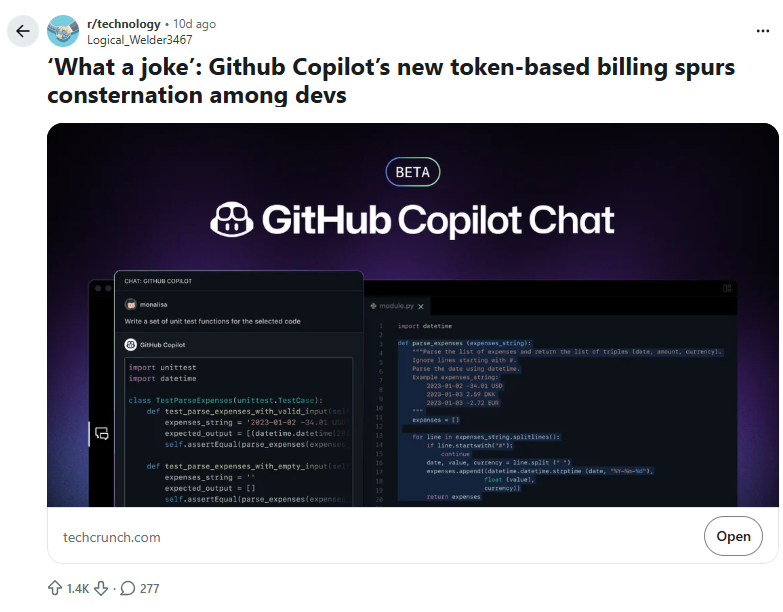
The era of unquestioned AI spend may be ending, and we think a lot of companies are about to find out that usage and value were never the same thing. We’ve gone from plate stacking to token-maxxing. But at least at the buffet line, you got something useful in return for your money. More companies are finding that AI spend can scale much faster than AI outcomes. For all of Starbucks’ AI spend, they gave up on an AI inventory system just nine months after launch—despite being a supposedly ideal use case—because, well, it ended up creating more work than having humans do it.1
Of course, this isn’t unique to Starbucks. More and more firms are questioning all of this spend because they’re getting very little in return. Uber just announced a spending cap.2 Amazon removed its “churn and burn” leaderboard because it turns out that spending and productivity aren’t synonyms. And lastly, everyone’s favorite online complaint department, Reddit, is rapidly filling up.
All good things generally come to an end. Buffets work until someone starts charging separately for the carving station, dessert tray, and second trip through the line. Maybe we’re starting to see that in AI spend.
Until next time.
Subscribe for Fresh Weekly Takes
- Weekly market insights
- Perspectives shaped by 30 years of investing
- Unique institutional-quality insights, now available to individuals
What We’re Listening To
Dear reader, if you have made it to the end, thank you. We encourage you not only to read our Insights, but plenty of others as well. This week we are highlighting a podcast that’s currently top of mind, and while it ties into this week’s subject matter, this need not always be the case (how boring would that be?).
This week, check out the Better Offline Podcast: “Why AI Has No ROI”, where host Ed Zitron and economist Paul Kedrosky discuss “why nobody can find the ROI of AI, and why there won’t be a dotcom bubble-style recovery for AI data centers.”
END NOTES
1Cunningham, Waylon. “Exclusive: Starbucks Scraps AI Inventory Tool Across North America.” Reuters. 21 May 2026.
2Ropek, Lucas. “Uber Caps Employee AI Spending After Blowing Through Budget in 4 Months.” TechCrunch. 2 June 2026.
DEFINITIONS
Return On Investment (ROI) is a measure of how much profit or loss an investment generates relative to its original cost, expressed as net gain divided by the amount invested. A higher ROI generally indicates a more successful investment. For example, an ROI of 20% means the investment earned $0.20 for every $1.00 invested.
IMPORTANT INFORMATION
The information provided in this document does not constitute investment advice and no investment decision should be made based on it. Neither the information contained in this document or in any accompanying oral presentation is a recommendation to follow any strategy or allocation. In addition, neither is it a recommendation, offer or solicitation to (i) sell or buy any security, (ii) purchase shares in any investment fund that GQG Partners LLC and its affiliates (collectively “GQG”) may sponsor, offer or manage, (iii) establish any separately managed account, or (iv) implement any investment advice. It should not be assumed that any investments made or recommended by GQG in the future will be profitable or will equal the performance of any securities discussed herein. Before making any investment decision, you should seek expert, professional advice, including tax advice, and obtain information regarding the legal, fiscal, regulatory and foreign currency requirements for any investment according to the law of your home country, place of residence or current abode.
This document reflects the views of GQG as of a particular time. GQG’s views may change without notice. Any forward-looking statements or forecasts are based on assumptions and actual results may vary.
GQG provides this information for informational purposes only. GQG has gathered the information in good faith from sources it believes to be reliable, including its own resources and third parties. However, GQG does not represent or warrant that any information, including, without limitation, any past performance results and any third-party information provided, is accurate, reliable or complete, and it should not be relied upon as such. GQG has not independently verified any information used or presented that is derived from third parties, which is subject to change. Information on holdings, allocations, and other characteristics is for illustrative purposes only and may not be representative of current or future investments or allocations.
GQG Partners LLC is a wholly owned subsidiary of GQG Partners Inc., a Delaware corporation that is listed on the Australian Securities Exchange (ASX: GQG). GQG Partners LLC and its affiliates provide certain services to each other.
GQG Partners LLC is registered as an investment adviser with the US Securities and Exchange Commission. Please see its Form ADV Part 2, which is available upon request, for more information.
© 2026 GQG Partners LLC. All rights reserved. This document reflects the views of GQG as of June 2026.
