
Never commit yourself to a cheese without having first examined it.
-T. S. Eliot
For better or for worse, “creativity” isn’t typically associated with banking and finance, but it really should be.
Yes, the arts gave us movies, paintings, and sculptures. But think about all the things banking and finance gave us: collateralized debt obligations, loans backed by whiskey and wine, and of course, “Bowie Bonds”—asset-backed securities backed by David Bowie’s music royalties.1
But maybe the most creative loans of all are those backed by cheese. And not just any cheese—the King of Cheese: Parmigiano-Reggiano.
Leave it to the Italians, some of history’s most famous bankers, to come up with one of the most creative ways of getting funds out to the folks.
Credito Emiliano has been using the young version of the King of Cheese as collateral for loans for decades, dating all the way back to the 1950s.2 In fact, one of its subsidiaries currently holds more than €300M worth of the good stuff.
And while it may seem odd, it actually makes a lot of sense. Like Champagne—or German beer brewed under the Reinheitsgebot, the German Purity Law—Parmigiano-Reggiano is tightly regulated by origin, ingredients, and age. Because the cheese takes such a long time to mature, anywhere from 12 to 48 months, farmers need cash flow today. This quirky lending scheme helps provide it.
Good-quality stuff makes for good-quality collateral, which keeps farmers happy and keeps the good stuff—cheese—coming.
Most of the time.
Here’s the problem with cheese, though.
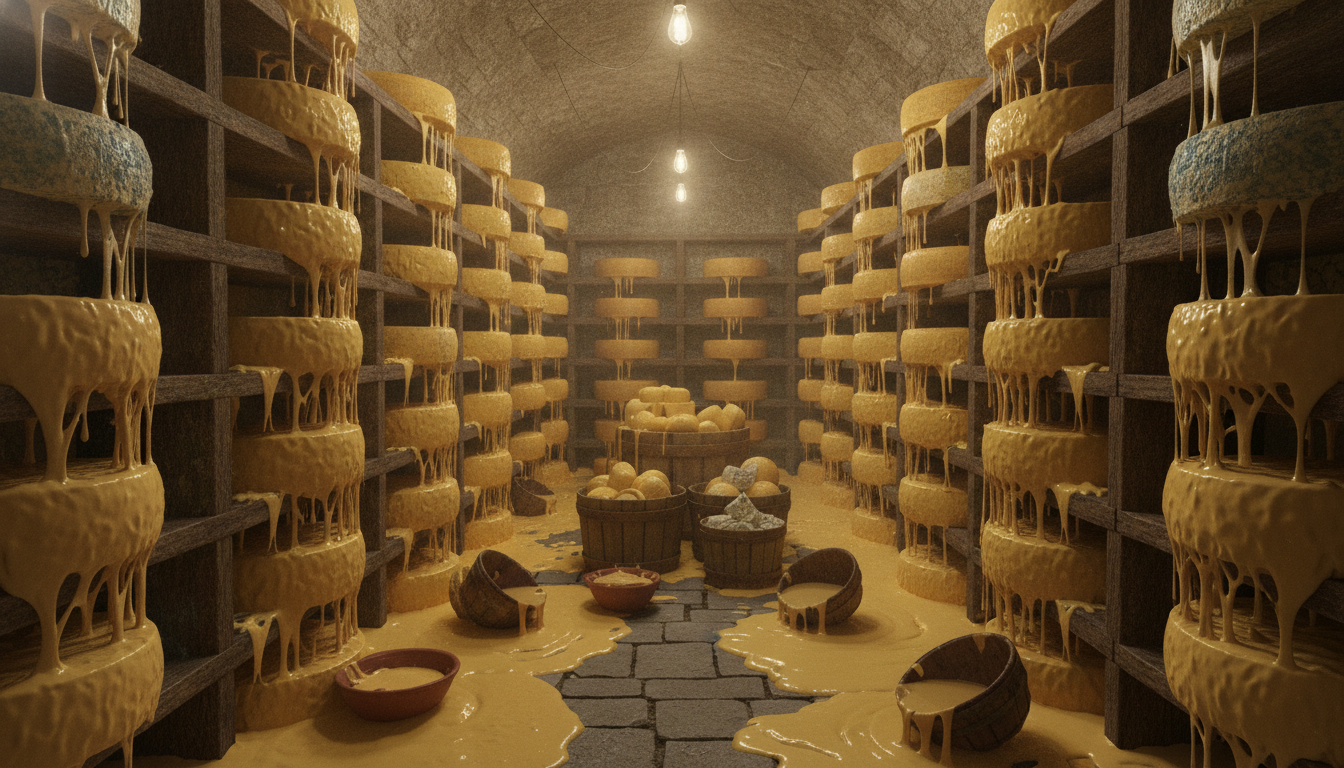
Unlike collateral such as an Italian car, cheese melts in the heat. As large swaths of Europe experience some of the hottest temperatures on record,3 that becomes a big problem when the “wheels” you’re lending against aren’t made of rubber.
The heat drives up energy costs, particularly for cooling, while requiring upgrades to insulation and infrastructure.
Beyond that, it creates a massive supply-chain problem, starting at the source. Like most people, cows don’t love the heat. When it’s too hot, they eat less and lie around more, ultimately affecting both the quality and quantity of their milk.
Who knew cheese could be the binding force bringing together economics, banking, and great food?
Fortunately, unlike collateralized debt obligations, melted cheese-backed loans probably won’t take down the entire global financial system.
But they could potentially make your pastas and salads a lot more expensive—should you choose to partake—or a lot less interesting, should you abstain.
Until next time.
Subscribe for Fresh Weekly Takes
- Weekly market insights
- Perspectives shaped by 30 years of investing
- Unique institutional-quality insights, now available to individuals
What We’re Reading
This week, in keeping with our food theme, we’re reading Mark Kurlansky’s Milk!: A 10,000-Year Food Fracas because, of course, you can’t have cheese without milk!
DEFINITIONS
A collateralized debt obligation (CDO) is a financial product that bundles many loans or debts together and sells them to investors, who receive payments as those loans are repaid.
END NOTES
1Chen, James. “Bowie Bonds: How Music Royalties Changed Investment.” Investopedia. 23 May 2026.
2Mealha, Quirino. “Extreme Heat Strains Italy’s ‘Cheese Banks,’ Where Parmigiano Backs Farm Loans.” Euronews. 11 August 2026.
3“Western Europe Records Hottest June on Record.” United Nations. 10 August 2026.
IMPORTANT INFORMATION
The information provided in this document does not constitute investment advice and no investment decision should be made based on it. Neither the information contained in this document or in any accompanying oral presentation is a recommendation to follow any strategy or allocation. In addition, neither is it a recommendation, offer or solicitation to (i) sell or buy any security, (ii) purchase shares in any investment fund that GQG Partners LLC and its affiliates (collectively “GQG”) may sponsor, offer or manage, (iii) establish any separately managed account, or (iv) implement any investment advice. It should not be assumed that any investments made or recommended by GQG in the future will be profitable or will equal the performance of any securities discussed herein. Before making any investment decision, you should seek expert, professional advice, including tax advice, and obtain information regarding the legal, fiscal, regulatory and foreign currency requirements for any investment according to the law of your home country, place of residence or current abode.
This document reflects the views of GQG as of a particular time. GQG’s views may change without notice. Any forward-looking statements or forecasts are based on assumptions and actual results may vary.
GQG provides this information for informational purposes only. GQG has gathered the information in good faith from sources it believes to be reliable, including its own resources and third parties. However, GQG does not represent or warrant that any information, including, without limitation, any past performance results and any third-party information provided, is accurate, reliable or complete, and it should not be relied upon as such. GQG has not independently verified any information used or presented that is derived from third parties, which is subject to change. Information on holdings, allocations, and other characteristics is for illustrative purposes only and may not be representative of current or future investments or allocations.
GQG Partners LLC is a wholly owned subsidiary of GQG Partners Inc., a Delaware corporation that is listed on the Australian Securities Exchange (ASX: GQG). GQG Partners LLC and its affiliates provide certain services to each other.
GQG Partners LLC is registered as an investment adviser with the US Securities and Exchange Commission. Please see its Form ADV Part 2, which is available upon request, for more information.
© 2026 GQG Partners LLC. All rights reserved. This document reflects the views of GQG as of August 2026.
