
I often say [there’s a] 10% to 20% chance [for AI] to wipe us out. But that’s just gut, based on the idea that we’re still making them and we’re pretty ingenious.1
– Geoffrey Hinton, Nobel Prize laureate and ‘Godfather’ of AI
If you were the CEO of an AI firm and truly believed there was at least a 10% chance that AI could wipe out humanity, how would you spend your time?
Would you focus on safeguarding the technology to make sure that risk never comes close to being realized? Or would you find yourself at a conference in San Francisco touting the benefits of integrating your models into one of the largest software applications in the world?
If you’re Dario Amodei, the CEO and co-founder of Anthropic, the answer is, apparently, a bit of both.
That question is not entirely theoretical. Jacob Coxon, a former employee of both OpenAI and Anthropic, recently made headlines for warning the public about the dangers of AI. In his view, if “we don’t slow down the current rate of progress, there is a strong chance we could all die in the immediate future.”2
Whether he’s correct, who knows. Let us hope he’s wrong.
But if any of these probabilities are remotely accurate, you would think the folks building this technology would want to put the brakes on it.
And they have…sort of.
In September 2026, following the Coxon news, Amodei published a piece titled “We Must Pace the Frontier” laying out a three-step plan for governing the development of increasingly capable AI systems. (Please feel free to read it for yourself or have AI summarize it for you.)
We think there are a few problems with this “plan,” though.
First, much of it calls for government intervention. While we don’t take political stances here, it’s a bit strange for a company that could certainly police itself to call for more government intervention in a space where companies are capable of constraining themselves.
If you’re developing something that can harm folks, you have the responsibility to keep that product off the market. This is obvious, and it applies to everything from haircuts to cars. Strict liability matters.
In fact, Jensen Huang, the CEO of Nvidia, who is just a tiny bit involved in this whole AI thing, recently laid out this exact case:
“If you’re going to build a self-driving car—let’s say it’s a robotaxi, and there’s a really difficult condition, as an engineer, we just have no idea how to solve this problem because these cars are not programmed, they’re trained. We have no idea how to train these cars, and we have no idea how to align them to the safety standards that are expected on the road,” Huang said. “What’s the answer? Don’t ship it.”3
To us, Amodei’s plan sounds less like a safety proposal and more like a blueprint for deciding who gets to compete. Put less charitably, it can sound like this: Hey, we may be in over our heads; we may have some issues with competition, so let’s make sure to keep some folks out of the industry to maintain our alleged moat under the guise of “safety.”
This doesn’t prove the safety concerns are insincere. It does, however, make the company’s stated alarm harder to square with its commercial urgency, in our opinion.
Which brings us back to San Francisco.
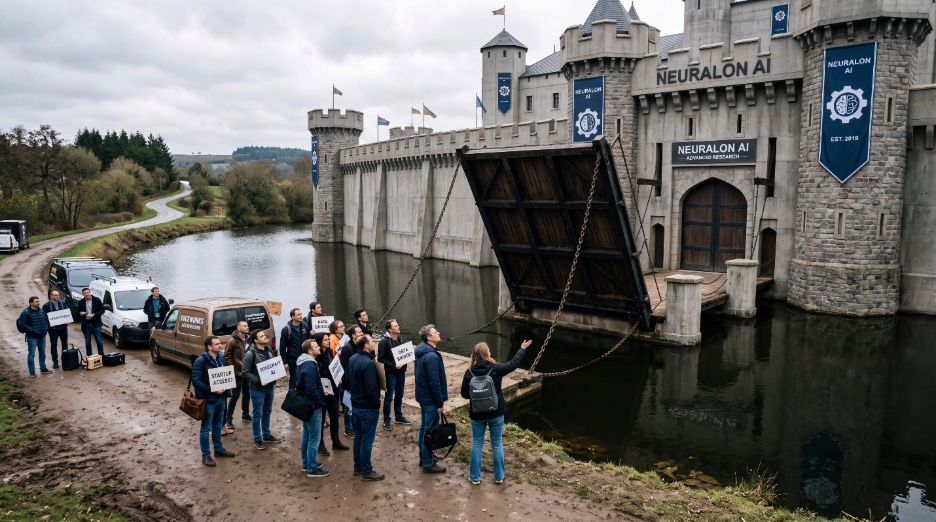
At the beginning of this piece, we posed a question: If you really thought there was more than a 10% chance that all of humanity would be gone within the next handful of years, would you put all of your effort into making sure it didn’t happen, or would you attend a conference in San Francisco?
Amodei is warning that capable AI models could lead to catastrophic outcomes, however remote. At the same time, he’s making time for photo ops with Salesforce CEO Mark Benioff to announce a partnership designed to bring Anthropic’s AI models deeper into the enterprise software stack, giving us “Claudeforce!”
That’s the tension, and it’s a little odd.
Amodei is worried about the end of humanity within the next few years. But along the way, he still has time for photo ops.4
Hey, we may all go away, but we’ll be really efficient with your data and your clients’ data as we get there.
Until next time.
Subscribe for Fresh Weekly Takes
- Weekly market insights
- Perspectives shaped by 30 years of investing
- Unique institutional-quality insights, now available to individuals
What We’re Reading
This week, as with many weeks, we’re spending a lot of time with machines and robots. For a long, dense, but fascinating take on AI, we’re reading Jobst Landgrebe and Barry Smith’s tome Why Machines Will Never Rule the World: Artificial Intelligence Without Fear.
END NOTES
1Huddleston Jr., Tom and Ashton Jackson. “There’s a ’10% to 20% Chance’ That AI Will Displace Humans Completely, Says ‘Godfather’ of the Technology.” CNBC. 17 June 2025.
2Kola, Paulin and Lily Jamali. “Anthropic Boss Dario Amodei Calls for AI Development to Slow Down.” BBC. 12 September 2026.
3Dellinger, AJ. “Jensen Huang Says if AI Companies Can’t Contain Their Models, ‘We Have to Shut the Labs Down’.” Gizmodo. 23 September 2026.
4“Dario Amodei x Marc Benioff: Making Use of Salesforce’s Data Fluently with Claude.” YouTube. 23 September 2026.
IMPORTANT INFORMATION
The information provided in this document does not constitute investment advice and no investment decision should be made based on it. Neither the information contained in this document or in any accompanying oral presentation is a recommendation to follow any strategy or allocation. In addition, neither is it a recommendation, offer or solicitation to (i) sell or buy any security, (ii) purchase shares in any investment fund that GQG Partners LLC and its affiliates (collectively “GQG”) may sponsor, offer or manage, (iii) establish any separately managed account, or (iv) implement any investment advice. It should not be assumed that any investments made or recommended by GQG in the future will be profitable or will equal the performance of any securities discussed herein. Before making any investment decision, you should seek expert, professional advice, including tax advice, and obtain information regarding the legal, fiscal, regulatory and foreign currency requirements for any investment according to the law of your home country, place of residence or current abode.
This document reflects the views of GQG as of a particular time. GQG’s views may change without notice. Any forward-looking statements or forecasts are based on assumptions and actual results may vary.
GQG provides this information for informational purposes only. GQG has gathered the information in good faith from sources it believes to be reliable, including its own resources and third parties. However, GQG does not represent or warrant that any information, including, without limitation, any past performance results and any third-party information provided, is accurate, reliable or complete, and it should not be relied upon as such. GQG has not independently verified any information used or presented that is derived from third parties, which is subject to change. Information on holdings, allocations, and other characteristics is for illustrative purposes only and may not be representative of current or future investments or allocations.
GQG Partners LLC is a wholly owned subsidiary of GQG Partners Inc., a Delaware corporation that is listed on the Australian Securities Exchange (ASX: GQG). GQG Partners LLC and its affiliates provide certain services to each other.
GQG Partners LLC is registered as an investment adviser with the US Securities and Exchange Commission. Please see its Form ADV Part 2, which is available upon request, for more information.
© 2026 GQG Partners LLC. All rights reserved. This document reflects the views of GQG as of September 2026.
