
Welcome to Canada, it’s the Maple Leaf State.
Canada, oh Canada it’s great!
The people are nice and they speak French too.
If you don’t like it, man, you sniff glue…
– Five Iron Frenzy, “Oh Canada”
What a difference nearly 30 years makes.
In 1997, when ska music was a thing (at least for some of us), Five Iron Frenzy really captured the zeitgeist of US-Canada relations: familiar, friendly, and a little goofy.
Much like the British Invasion of music during the 1960s, Canada’s invasion of US culture during the 1990s was a real hit.
As a trusted news source from the north, the CBC, fondly put it: “…in the 1990s, Canada quietly took over American popular culture. Toronto stood in for New York and Chicago in countless movies, The X-Files was shot in Vancouver, and Americans couldn’t turn on the radio, watch TV, or go to the movies without seeing one of us.”1
My, how things have changed.
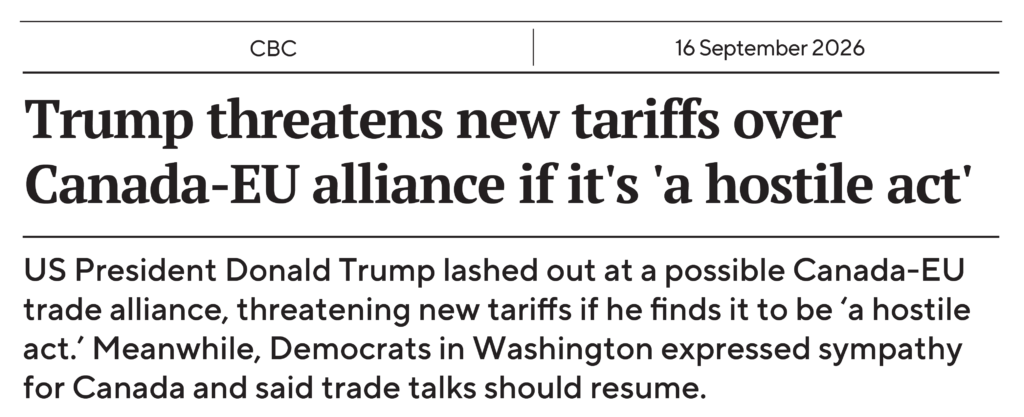
Fast forward to today: as of mid-September, the CBC homepage tells a less neighborly story.2
Like two brothers who have had a massive falling out, you really hate to see it.
The US-Canada trade relationship is not collapsing, but it’s becoming more expensive, less predictable, and more political. For businesses that have relied on a relatively frictionless border, the consequences are tangible: higher costs, thinner margins, more difficult capital-planning decisions, and supply chain uncertainty.
The two countries have always had back-and-forth tariff negotiations. Even during the NAFTA era, one trade dispute remained a persistent “soft spot”: softwood lumber, naturally.
Lumber remains a big deal because, as the Royal Bank of Canada points out, the US relies on imports to meet domestic demand, and Canada supplies the bulk of those imports.
“Roughly 30% of US lumber consumption comes from imports. That mainly comes from Canada, where exports accounted for roughly 71% of US imported softwood lumber, valued at approximately US$4.5B in 2025.”3
That’s not just a Canadian exporter story. Higher lumber costs can flow through to US homebuilders, renovation activity, and ultimately, homebuyers—who did not exactly need another reason to dislike the housing market.
Unfortunately, things don’t just stop at lumber. The recent tit-for-tat tariffs on a host of goods, from booze to dairy products, make it feel like our social integration is coming to an end. In fact, that’s precisely how a recent article from the Council on Foreign Relations framed it.4
Even Canada’s current Prime Minister, Mark Carney, got some laughs at a recent event after the EU welcomed Canada as an associate member.
He was not seeking to form a “third bloc” to act as “a great-power rival” to Washington and Beijing, “only better manners,” Carney said in a line that drew laughs.
“We do not seek power to dominate others. On the contrary, we are pursuing resilience, so that no one can control our open markets, impair our sovereignty, threaten our territorial integrity, or undermine our freedoms, our democracies, our rule of law.”5
Hopefully, we don’t get to the point of irreconcilable differences, not only because we’re neighbors and free voluntary trade makes everyone better off, but also because tariffs and retaliation could force companies to reconsider business models built around an open, integrated North American market.
The near-term watchlist is straightforward: lumber and homebuilders; autos and parts suppliers; agriculture; energy; railroads; and any company whose “domestic” supply chain quietly crosses the border three times before lunch.
If retaliation spreads into autos, energy, or critical minerals, it will no longer be a Canadian earnings story. It will be a North American one.
And if we can’t come to terms on trade, we’ll just have to settle our disputes the old-fashioned way: with a good ol’ fashioned hockey game.
Until next time.
Subscribe for Fresh Weekly Takes
- Weekly market insights
- Perspectives shaped by 30 years of investing
- Unique institutional-quality insights, now available to individuals
What We’re Reading
It may sound boring, but this week’s selection is both fitting and interesting: we’re reading Douglas Irwin’s 800-plus-page beast of a book: Clashing Over Commerce–A History of US Trade Policy.
END NOTES
1Dart, Chris. “In the 1990s Canadians (Secretly) Invaded America.” CBC. 16 July 2018.
2“Trump Threatens New Tariffs Over Canada-EU Alliance if It’s ‘a Hostile Act’.” CBC. 16 September 2026.
3Zanzana, Salim. “Decades of Trade Disputes Reshape Canada’s Softwood Lumber Sector.” RBC. 25 February 2026.
4Lindsay, James. “The US-Canada Trade War Could Mark a Breaking Point.” Council on Foreign Relations. 16 September 2026.
5Melander, Ingrid, Charlotte Van Campenhout, and Yves Herman. “Canada and EU Should Ally to Protect Democracies, Carney Says, After ‘Associate Member’ Proposal Angers Trump.” Reuters. 17 September 2026.
IMPORTANT INFORMATION
The information provided in this document does not constitute investment advice and no investment decision should be made based on it. Neither the information contained in this document or in any accompanying oral presentation is a recommendation to follow any strategy or allocation. In addition, neither is it a recommendation, offer or solicitation to (i) sell or buy any security, (ii) purchase shares in any investment fund that GQG Partners LLC and its affiliates (collectively “GQG”) may sponsor, offer or manage, (iii) establish any separately managed account, or (iv) implement any investment advice. It should not be assumed that any investments made or recommended by GQG in the future will be profitable or will equal the performance of any securities discussed herein. Before making any investment decision, you should seek expert, professional advice, including tax advice, and obtain information regarding the legal, fiscal, regulatory and foreign currency requirements for any investment according to the law of your home country, place of residence or current abode.
This document reflects the views of GQG as of a particular time. GQG’s views may change without notice. Any forward-looking statements or forecasts are based on assumptions and actual results may vary.
GQG provides this information for informational purposes only. GQG has gathered the information in good faith from sources it believes to be reliable, including its own resources and third parties. However, GQG does not represent or warrant that any information, including, without limitation, any past performance results and any third-party information provided, is accurate, reliable or complete, and it should not be relied upon as such. GQG has not independently verified any information used or presented that is derived from third parties, which is subject to change. Information on holdings, allocations, and other characteristics is for illustrative purposes only and may not be representative of current or future investments or allocations.
GQG Partners LLC is a wholly owned subsidiary of GQG Partners Inc., a Delaware corporation that is listed on the Australian Securities Exchange (ASX: GQG). GQG Partners LLC and its affiliates provide certain services to each other.
GQG Partners LLC is registered as an investment adviser with the US Securities and Exchange Commission. Please see its Form ADV Part 2, which is available upon request, for more information.
© 2026 GQG Partners LLC. All rights reserved. This document reflects the views of GQG as of September 2026.
